




Julius Rublack

Julius Rublack
PhD Student
Associated Project 12
AP12: Role of eosinophil subpopulations in allergic asthma and other eosinophil driven diseases
|
Julius Rublack
Dunja Bruder |
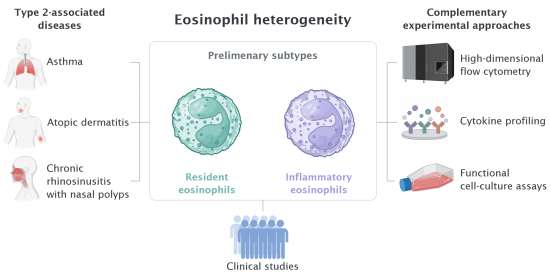
Eosinophils are key effector cells in allergic diseases involving a Type 2 response, such as asthma, atopic dermatitis, or chronic rhinosinusitis with nasal polyps In routine clinical practice, eosinophils are currently only recorded as a single biomarker based on their count, which likely underestimates the complexity of this cell population and its significance for the respective clinical conditions. Recent studies show that eosinophils can be classified into resident and inflammatory subtypes based on surface receptors, which may be associated with disease control and response to therapy. However, this classification remains incompletely defined, particularly with regard to its functional interpretation within the broader Type 2 immune network, and the contribution of the distinct eosinophil subtypes to disease pathogenesis. The aim of this project is therefore to use a combination of high-dimensional flow cytometry, cytokine profiling and functional cell-culture assays to systematically characterize eosinophil subtypes across Type 2-associated diseases. This will enable to gather insights about disease control and typ-2-immune response.
Eosinophil heterogeneity in type 2-associated diseases remains incompletely understood. Recent literature hints on two subtypes (resident eosinophils and inflammatory eosinophils) in asthma but their role in the diseases require further investigation. The project aims to gather insights into eosinophil biology and heterogeneity in the broader context of the type 2 immune response by using high-dimensional flow cytometry together with cytokine profiling and cell culture assays in clinical studies. |


Photos: by UMMD, Melitta Schubert/Sarah Kossmann