





MD15: Mast cell granules as regulators of LPS-induced macrophage tolerance
|
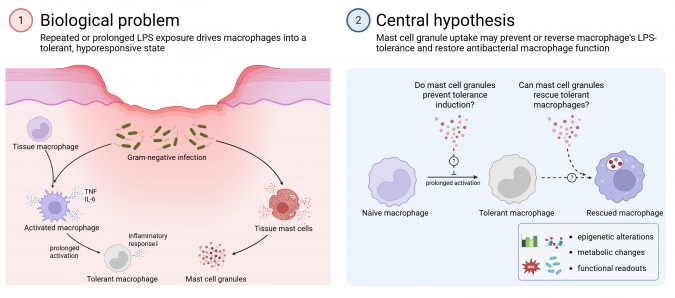
Repeated exposure to LPS can induce tolerance in macrophages, reducing their responsiveness to subsequent infections. This protects tissue by limiting excessive inflammation, but can also allow bacteria to persist, spread, and cause sepsis. Preliminary data from our group shows that mast cells (MCs) and macrophages are closely associated in barrier tissues such as the skin. We found that intact mast cell granules (MCGs) are engulfed by macrophages in murine models in vivo and in vitro. This uptake enhances macrophage function and induces a unique plasticity, combining features of both classically and alternatively activated states, suggesting improved versatility. These findings were confirmed with human MCs and macrophages in vitro and in situ, in healthy skin explants and psoriatic patient lesional skin. Additionally, MCG uptake alters phenotypic and functional changes of macrophages to LPS, suggesting that MCGs have the potential to modulate endotoxin-induced changes. This project explores whether MCGs help macrophages regain antibacterial functions under conditions where LPS tolerance would normally be detrimental. Our early observations suggest that MCGs modulate the tolerant state of macrophages in vitro, thus supporting this hypothesis. In particular, we can see a trend towards a restored cytokine response and significant reversal of phenotypic markers in samples receiving MCGs. Understanding how MCG uptake regulates LPS tolerance could reveal new therapeutic targets. Preserving macrophage responsiveness is essential for maintaining barrier integrity and effective early immune defense.
(1) Infection with Gram-negative bacteria causes a strong inflammatory response in tissue-resident macrophages. However, after prolonged contact, macrophages enter a tolerant state and thereby diminished pro-inflammatory response. (2) The uptake of mast cell granules by macrophages before or after tolerization with LPS may prevent tolerance induction or break already induced LPS tolerance, respectively. |


Photos: by UMMD, Melitta Schubert/Sarah Kossmann